


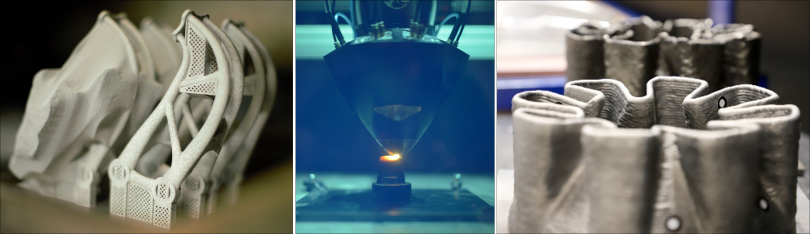
Digital advancements, the growth of additive manufacturing technologies, and an increasing awareness of societal and environmental challenges are significantly impacting how manufactured products are designed and produced. In response to these changes, the CIPP team adapts by creating models and methods based on expert experience and knowledge. The team provides tools that enable the mastery of manufacturing processes and the design of products that integrate both technical constraints and societal and environmental needs.
The core strengths of the team’s projects lie in their relevance and their focus on addressing scientific challenges in the following areas:
- Additive and Hybrid Manufacturing: Modeling, Simulation, and Optimization (Product-Process)
To master the implementation of additive manufacturing, it is essential to understand complex, multi-physics phenomena occurring at both microscopic and macroscopic scales. The team works on creating modeling and process optimization tools to improve production quality.
- Design, Topology, and Multi-physics Optimization; Remanufacturing
These new production tools have specific design requirements but also offer incredible opportunities to meet the societal and environmental challenges of tomorrow. It is becoming both possible and necessary to implement new design approaches (topology and multi-physics optimization) that integrate every stage of a product life cycle, from production and use to remanufacturing and repurposing, right from the initial design phase.
- Knowledge Engineering and Decision Support Tools
The complexity of these new processes and design tools can be a barrier to their widespread adoption. To overcome this, the CIPP team develops tools to assist users in their design and manufacturing processes. These tools are the result of analyzing and formalizing expert knowledge. They leverage advanced expertise to support users, who retain full decision-making authority, as they navigate future challenges.
Our expertise in design integration, built on 20 years of practice, allows us to approach today’s integration challenges with greater proficiency, particularly in:
- Product-process design
- Design and implementation methods
- Knowledge formalization
- Decision support in design and manufacturing
- Phenomenological modeling
- Digital chains (CAD, CAE, CAM)
- Quality control and correction
Our work is recognized both nationally and internationally, and many PhD students, post-doctoral researchers, and faculty members seek to join and train with us. Due to its structure and potential, additive manufacturing attracts a large number of doctoral candidates and engineering students, alongside a very strong industrial demand for R&D in this field.